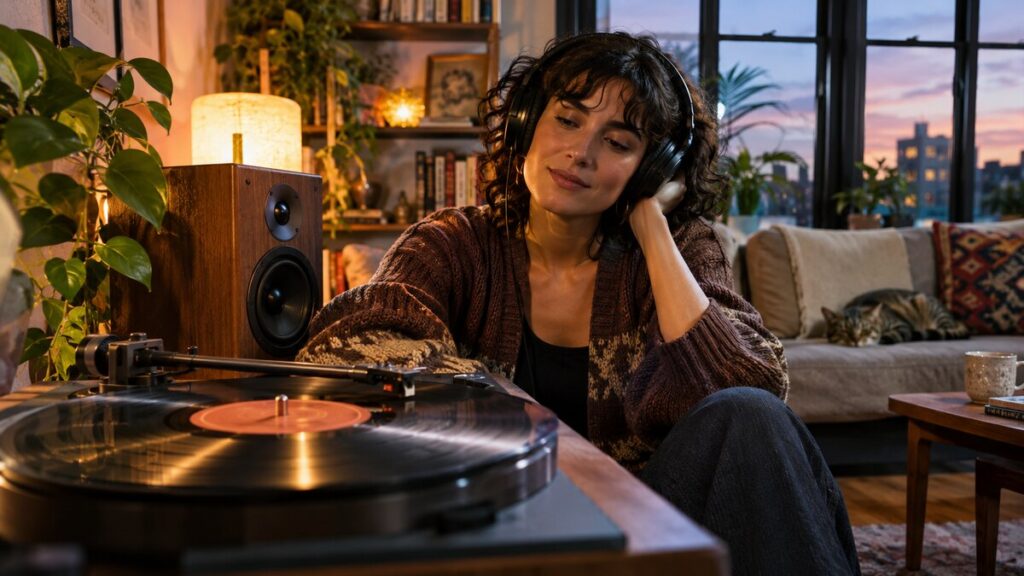
Someone listening to a familiar record points out a patch of space between two notes. Yesterday the notes seemed almost joined. Tonight, after cannabis, the gap seems wide enough to step into. There is no need to doubt that description to ask a harder question. What evidence would tell us whether the listener’s ability to distinguish sounds had changed, or whether they had simply begun attending to the gap?
Four people worth listening to individually
Jörg Fachner’s study of cannabis and music perception combined accounts of listening with recordings of electrical brain activity in a familiar setting. The work examined four individual cases before and after cannabis. Keeping the setting recognizable to the participants was part of the point. Researchers interested in what listeners find striking risk stripping away the very circumstances in which they notice it.
Four cases allow an investigator to dwell on a phrase, follow a change within one listener and note disagreement that would vanish in an average. They give very little purchase on how common the experience is. One participant’s description may suggest a productive experiment even if the other three never say anything like it. The claim that a phenomenon exists in someone’s account and the claim that most people experience it require different evidence.
What the electrodes add
Electroencephalography, or EEG, records electrical signals at the scalp. Investigators can examine how the strength of activity in particular frequency ranges changes across a session. Fachner reported changes in several ranges and discussed them in relation to altered attention to music. The sound of the bass player cannot be read out of an electrode. The participant supplies the experience to which the investigator is trying to relate the signal.
Consider a listener who closes their eyes during a favorite passage. There may be a change in a scalp recording, a change in attention and a vivid new listening experience, all at once. Establishing which change accounts for which other one requires a comparison. A carefully observed case can make the conjunction visible. It seldom includes all the alternative conditions that would settle the causal story.
The freedom to choose a track has consequences
At home, the choice of record may be part of what cannabis changes. An experience-sampling study of everyday music selection asked what people played and in what circumstances, capturing choices a fixed playlist removes. A person can replay a passage, turn up a quiet instrument or switch to an album associated with a particular friend. In an experiment that fixes the track and its duration, those choices disappear. An investigator gains the ability to compare like with like while losing some of the behavior that made the subject interesting.
A controlled brain-imaging experiment took that bargain explicitly. Sixteen participants attended three sessions and listened to music and scrambled sounds under different cannabis or placebo conditions. This design could compare the same listener under defined conditions. The naturalistic approach could give an extended hearing to details that a standard excerpt and a short rating scale might never elicit. Apparent disagreement between the studies can begin with the fact that they listened for different things.
A test hidden in a description
Return to the seemingly enlarged gap. One follow-up would be to play pairs of sounds separated by subtly different intervals and ask the listener which interval was longer. Another would leave the recording untouched and ask where the listener’s attention went. The first measures discrimination. The second investigates the distribution of attention. Experiments on THC and interval timing give a third reason to take the wording of the task seriously, since producing a duration and estimating one are different operations.
It is easy to make a small observational study sound grander by calling it proof that music becomes richer. Its more lasting contribution may be that it gave a listener time to describe the gap. A researcher can take that detail back to the laboratory and build a question precise enough for someone else to answer.