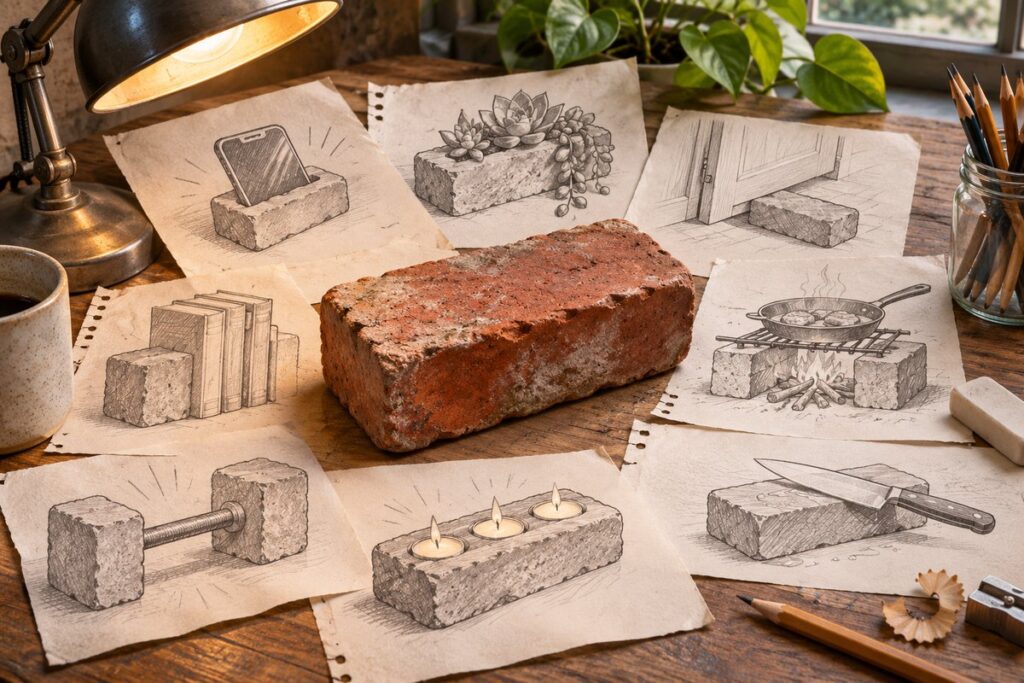
Give two people a brick and ask them to think of unusual things to do with it. One proposes a doorstop, a paperweight and a weight for pressing flowers. The other suggests grinding it into red pigment. Who has shown more imagination? Count the answers and the first person wins. Ask how far each person travelled from the ordinary idea of something heavy, and the second person has a case.
Neither list came from a laboratory. They illustrate a real problem in experiments on cannabis and creativity, where an investigator must decide in advance what a creative performance looks like. A participant can have a wonderful time thinking about a brick. At the end of the session, somebody still has to score what went down on paper.
One answer sheet, several scores
Psychologists call the exercise an Alternate Uses Task. The participant starts with one familiar object and generates possible uses for it, a process called divergent thinking. Fluency is the simplest score. Count the acceptable, distinct responses. Flexibility asks how many kinds of use the list covers. Three different ways to hold things down might earn three fluency points and only one point for flexibility, depending on the scoring rules.
Originality poses a trickier question. One approach rewards answers that occur infrequently in a particular group. A suggestion that seems dazzling among people who have never handled clay might be obvious in a room full of potters. Elaboration is different again. A participant might add considerable detail about how to grind and apply the pigment while adding precisely zero new uses to the list.
Long lists also create more opportunities to hit on something rare. Some researchers therefore have judges score the best answers rather than simply reward every additional entry. A study of scoring methods compared ratings averaged across a person’s answers with ratings for the two the person selected as their best. These methods pose different challenges. Producing one excellent idea and recognizing it as excellent can each affect the second score.
What happened after vaporized cannabis?
In a controlled study of regular cannabis users, Mikael Kowal and colleagues assigned participants to vaporized cannabis containing a lower or higher amount of THC, or to placebo. Eighteen people were assigned to each condition. Everyone had a limited time in which to produce alternate uses. The researchers also used a word-association task that required finding a single word connecting a set of clues, an example of convergent thinking.
The group assigned to the higher THC condition performed worse on measures of divergent thinking than the other groups. The lower THC condition showed no advantage over placebo. A small group, a particular route of administration and a timed exercise all matter when interpreting that result. A composer revising a piece over several evenings has a very different job from someone producing a string of uses for a household object while a timer runs.
How an idea feels from the inside
There is another possible judge in the room. The person who came up with the ideas can rate how creative they seem. In separate research on cannabis and creativity judgments, cannabis use was associated with more favorable evaluations of creative work without a corresponding gain in creativity as assessed independently. Enjoyment of an idea can be genuine even when another reader gives it an ordinary score.
Return to the brick and change the assignment slightly. Suppose the next step is to choose one idea and develop it into a workable exhibit. Someone now has to evaluate materials, anticipate a visitor’s reaction and revise a design. The original score sheet contains valuable information about how each participant started. Much of what will determine the quality of that exhibit has yet to happen.