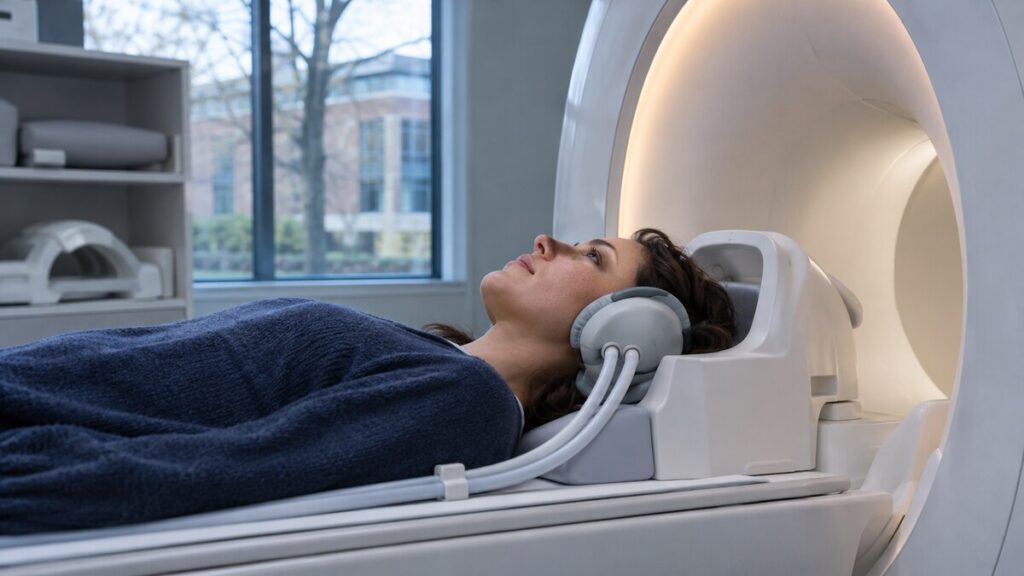
Inside a brain scanner, even an excellent pair of headphones has an unusual rival for the listener’s attention. The machine has its own emphatic rhythm, and the listener has to keep still. This is an odd place to investigate the pleasure of music. It does, however, let scientists ask a question that a concert review never could. Does a change in how music feels after cannabis correspond to a change in how the brain responds to sound?
Sixteen listeners and a scrambled soundtrack
In an experiment on cannabis and music, sixteen cannabis users took part in three sessions. They experienced cannabis containing THC with CBD, cannabis containing THC without CBD, and placebo. The researchers compared responses to music with responses to excerpts of scrambled sound. Each listener supplied their own comparison across sessions, an advantage in a field where one person’s absorbing passage may leave another checking the time.
The scrambled excerpts served a specific purpose. Playing a song and comparing the result with silence would mix many effects. Sound has started, the ears have something to process, and the listener now has a passage of music to follow. A scrambled comparison retains sound while disturbing its musical organization. It cannot control every difference between the two experiences, but it narrows what the contrast is likely to mean.
What a bright patch signifies
Functional magnetic resonance imaging detects changes related to blood oxygenation. Researchers use those changes as an indirect measure of activity. A colored region in a figure usually reflects a statistical comparison, not a photograph of pleasure occurring in one place. If the figure represents music relative to scrambled sound, then a smaller response means the difference between those conditions was smaller. Reading the label on the comparison matters just as much as recognizing the region’s name.
In the condition containing THC without CBD, the investigators observed a reduced response to music relative to placebo in several regions, including areas involved in hearing, reward and emotion. The full report sets the regional findings beside the participants’ reports. Asking how much someone enjoys music and measuring a difference in a blood-oxygen signal are distinct ways of listening to the same session. In a separate study of musical anticipation and peak emotion, the build-up to a favorite passage and the peak itself had distinguishable signatures. There is no scale that converts one unit of brain response into a unit of musical pleasure.
The temptation to explain someone’s taste
Imagine a listener who becomes absorbed in a single bass line and pays less attention to the rest of an arrangement. That listener might describe the song as newly compelling. A second person might describe the same narrowing of attention as a loss. No scan alone can decide which word either person should choose. Nor could a study of sixteen participants reveal how every listener responds across an evening’s worth of familiar and unfamiliar music.
An earlier naturalistic study pairing listening accounts with EEG approached essentially the same fascination from another direction. It paid close attention to how people described changes in the space and detail of what they heard. Such accounts give a researcher ideas about which feature of a listening experience to manipulate next. They do not by themselves identify the cause of the change.
The silence between comparisons
The scanner experiment gains precision by repeating a restricted listening situation. Its limitations begin in exactly the same place. There is no dance floor, little room for movement and no bandmate reacting to the same chord. The question it answers is consequently much smaller than whether cannabis makes music better. It asks how a defined preparation changes the response of particular listeners to a defined musical contrast.
That smaller question has an audible consequence for anyone reading the study. When a headline says the brain responded less to music, mentally restore the missing second track. The experiment always had two soundtracks, the organized passage and its scrambled counterpart. Only with both playing does the reported difference have its intended meaning.